Showing posts with label participation. Show all posts

Friday, June 23, 2023

USTA League Mixed Participation - A preliminary look at some USTA League statistics for 2023

 I've been doing some mid-year looks at participation for 2023 to get a preliminary idea of what any continued recover post-COVID there is or if the general decline we've observed since 2013 may be continuing.  I even took a look by section, first warm weather sections, then the rest, and saw some sections are declining faster, and a few have actually shown growth.

In doing that analysis, I looked at only the main Adult advancing leagues as I've done that each year and it provides consistency for comparing things year to year.  I thought it would be interesting to also look at Mixed, so this post will dive into that.

For this analysis I'm looking at unique participants during the USTA rating year in the 18 & Over or 40 & Over Mixed leagues.  This is unique participants, not total registrations, so someone playing in both leagues or multiple levels will be counted just once.

Also, since the USTA had a 2-year rating period for 2020/2021 due to COVID, I'm grouping those as a single "year".  As you  might expect, when I've looked at them individually in the past, 2020 was way down, and 2021 recovered some but not all the way to 2019 (or 2022) levels.

Here are the overall participation stats for Mixed!

This may be the first time I've done this for Mixed, so we actually get a view into the years from 2013 and on to see how it compares with the trend in Adult.  From 2013 to 2018, Adult dropped about 7-8% and here it is similar, although the bulk of the drop was in 2018.  There was a slight recovery in 2019 like Adult leagues also saw, but Mixed was a bit larger.  Combining the COVID years also shows a greater bump than Adult, and then a similar drop in 2022.  So overall Mixed participation very much mirrors Adult.

What is interesting is that 2023 is way behind 2022 at this point.  That is alarming at first, but a number of sections run Mixed leagues either in the Summer so just starting, or as early start leagues so still to be played, so much of that gap is due to that.

Another observation is that Mixed obviously requires the same number of men and women on the court, but every so slightly more women participate than men.  My observation locally is that to ensure player availability, teams often have more women than men, so this seems to back that up.

Next, I went ahead and looked at unique participants across Adult and Mixed.  Adult showed 275K in 2013 and Mixed shows 91K, so do these get added together?  Alas no as many players play both so only get counted once when looking at the combined stats.

Here is the chart.


Since the trends are similar in each category by themselves, combined we see the same trend.

It is interesting that in 2013 the combined number is 296K which tells us that about 21K appear to have played Mixed but not Adult that year.  In 2022 it was 243K in Adult and 262K combined so about 19K playing only Mixed.

What do you think?


Note: These are statistics from the data I've gathered for calculating my ratings and generating reports and may not exactly match the USTA's data or they may report numbers using different criteria than I am.

Thursday, June 22, 2023

A preliminary look at some USTA League statistics for 2023 - Overall participation by Section - The rest of the sections

I've started taking a preliminary look at some participation numbers from USTA League play for 2023 and started with the overall numbers, now I'm digging in to look at the numbers by section.

As a reminder, I'm looking at participation only in the advancing leagues for consistency across the years.  This means if participation is up or down in Mixed or Tri-Level or other alternate leagues, the charts I create won't show that.

And I'll stress again that the 2023 numbers are preliminary, they can and will go up, in part based on where league play is to date, and also if a section will have early start leagues in the Fall.  But I think it is still interesting to see where they stand right now.

I already looked at the warm weather sections, now the rest of them.  Will these have significant different participation and/or have gotten a COVID bump from the additional players the TIA and USTA tell us picked up the game?

We'll go sort of largest to smallest starting with the largest of these sections, Midwest.

Midwest kind of follows the National trend to a point, but did not get a COVID 2-year period bump, dropped further in 2022, and is way down so far for 2023.  At this rate, they may not be the largest of this group of sections much longer.

Next up, Intermountain.

Intermountain has been close to flat, did get a little COVID 2-year period bump, then a small drop in 2022.  2023 still has a bit to match 2022.

Next, Mid-Atlantic.


A "national following" trend for the most part.  The 2-year COVID period was flat though, and a significant drop in 2022, although 2023 is looking close to the same.

Next, New England.

New England was flat through 2019, but struggled in 2020/2021 and dropped further in 2022.  2023 may still match 2022.

Next, Eastern.

This was mostly flat through 2019, but was hit hard by COVID and recovered slightly in 2022, but 2023 is behind so far.

Next, the Pacific Northwest.

This section had shown some very small growth through 2019, one of the few to do so, but was hit by COVID and 2022 fell a bit more.  2023 is looking pretty good in comparison though.

Next, Middle States.

Just a slight drop through 2019 here, a little hit from COVID but 2022 inched up, but 2023 is behind.

Next, Missouri Valley.


Very flat through 2019, but really saw a bump during the 2-year COVID period, and 2022 remained up from 2019.  2023 may match it by the end too.

Last, Northern.

Pretty flat to even a little  growth through 2019, but 2022 dropped and 2023 has dropped even more it appears.

Any surprises from what you see?  While all are warm weather sections. several have had significant drops, much more drastic than the national average, while Southwest, SoCal, and Florida have shown some modest gains.

How does this compare with what you've observed locally?

Wednesday, June 21, 2023

A preliminary look at some USTA League statistics for 2023 - Overall participation by Section - The warm weather sections

I've started taking a preliminary look at some participation numbers from USTA League play for 2023 and started with the overall numbers, now I'm digging in to look at the numbers  by section.

As a reminder, I'm looking at participation only in the advancing leagues for consistency across the years.  This means if participation is up or down in Mixed or Tri-Level or other alternate leagues, the charts I create won't show that.

And I'll stress again that the 2023 numbers are preliminary, they can and will go up, in part based on where league play is to date, and also if a section will have early start leagues in the Fall.  But I think it is still interesting to see where they stand right now.

In this post I'll take a look at the warm weather sections.  One might think that the sections where players can play pretty much year-round would be the most likely to maintain participation and/or have gotten a COVID bump from the additional players the TIA and USTA tell us picked up the game.

We'll go sort of largest to smallest starting with the largest section, Southern.


First, in 2013 there were right at 80K players that played in Southern.  Given the overall number was around 275K, that means nearly 30% of player participation comes from a single section!  That means whatever the trend is in Southern will likely have a significant impact on the overall stats.

And we do see that there is a general decline down to just over 70K in 2018/2019/2022 and so far, 2023 is still several thousand short of that.

Next up, Texas.


Texas had a small drop through 2019, but had the 2-year COVID bump and then back to 2019 levels in 2022.  2023 is behind but still time to make up the gap.

Next up, Northern California.


Northern Cal showed a similar drop from 2013 to 2019, around 12%, but unlike Southern had a significant drop for 2020/2021 even combining the years.  2022 was down even more, although 2023 has already gotten to 2022 levels.

Next, another warm weather section, Florida.


Here we see the decline from 2013 to 2016, but since then an increase, and a large increase in the combined 2020/2021 COVID rating period.  2022 was up significantly from 2019, so it will be interesting to see if 2023 ends up matching it by year end.

Next we go to the rest of California, Southern Cal.


Here we see growth from 2013 and forward!  2020/2021 had a slight dip despite being a 2-year period and 2022 was down a bit more, but 2023 is already up slightly over 2022.

The last three are some of the smallest sections starting with Southwest.


Southwest was pretty flat from 2013 and on with very modest growth in 2017-2019 over 2013 levels.  It did have the bump from the 2-year period then back to about the prior years level in 2022.  2023 is still a bit behind but there is time to make it up.

Next, Hawaii.


Hawaii does show a pretty significant drop over the years, about 17% from 2013 to 2019, and was significantly hit during COVID and 2022 was down a bit more.  Still time for 2023 to match 2022 but right now, it is down more.

Last, Caribbean.


Here we see pretty flat numbers from 2013 to 2017, but then a significant drop, and COVID has a big impact with 2022 down even more.  2023 is looking better though already.

Any surprises from what you see?  While all are warm weather sections. several have had significant drops, much more drastic than the national average, while Southwest, SoCal, and Florida have shown some modest gains.

How does this compare with what you've observed locally?

The rest of the sections coming soon.

Monday, June 19, 2023

A preliminary look at some USTA League statistics for 2023 - Overall participation

It is mid-June and the calendar year is almost half over, and with it league play is in full force or even into the post-season in some areas.  That means for the most part players have signed up for teams and are playing and we can begin to take a look at some USTA League stats for 2023.

This will be a sequence of several posts as there is too much to fit into one.  To start, I'll take a look at overall participation.

For reference, here is my post from late last year looking at this metric through the end of 2022 where I also discuss different ways of looking at 2020/2021 COVID years.  I won't rehash that here and just show 2020 and 2021 as a combined single 'year' since that is how the USTA treated it for rating purposes and I'm using rating years for this analysis.  That does cause that 2 year period to look a bit high in comparison to other single year periods, but it is what it is.

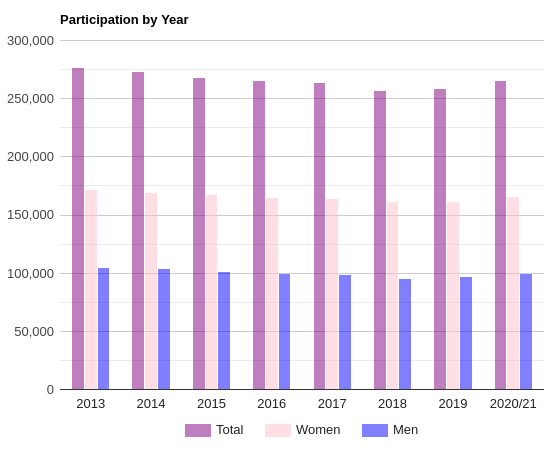
Here is preliminary 2023 unique player participation in the main Adult leagues.


The year is obviously not over yet, players could still sign-up and play on 2023 teams, and some areas will have early start leagues for 2024 play during the 2023 rating year so the 2023 participation number will go up, but there is a pretty substantial drop right now from just over 243K in 2022 to just over 222K this year.  And the drop is across both women and men in about equal percentages.

To compare apples to apples, I looked at what participation was in 2022 through June 19 and that number was 227K, so 2023 is only 5K behind at this point.  If that gap remains at the end of the year, it would be somewhat consistent with, but on the higher end, of the general trend you can see in the chart above.  Most years have seen about a 3K decrease, but a few have been higher or lower than that, and only 2019 showing a real increase (about 1K).

It would seem then that participation in the main Adult USTA Leagues continues to decline.  We'll see where we end up at at the end of the year.


Note: These are statistics from the data I've gathered for calculating my ratings and generating reports and may not exactly match the USTA's data or they may report numbers using different criteria than I am.


Related: A look at the same stats by warm weather sections.  And the rest of the sections.  Then a look at Mixed.

Saturday, November 5, 2022

USTA Adult League Participation 2013 thru 2022 - Participation is up! No, wait, it is down. Well, ...

I'm starting my year-end statistics and analysis a little earlier than normal this year.  I normally wait for year-end ratings, but some of the analysis isn't dependent on them, namely participation numbers.  Since my analysis uses the USTA rating year period and that just closed for 2022, I can do this analysis now.

I've done this analysis in past years, so I'm continuing the same methodology this year which is to look at unique players that played in the main Adult leagues, i.e. 18 & Over, 40 & Over, 55 & Over, and 65 & Over.

As I noted last year, trying to make sense of 2020/2021 is difficult due to how COVID disrupted league play.  I did generally treat 2020/2021 as one "year" in my analysis but did take a look at how things looked if they were treated as separate years as well.  I'll do some of the same below.

First, here is participation across all of the main Adult leagues treating 2020 and 2021 as separate years.


Participation is up over 10% over 2021!  Tennis is growing!  Well, yes, the stats show there was an increase over last year, but remember last year was still recovering from the COVID shortened 2020 that was down 23% from 2019.  This is why I had combined 2020/2021 for much of my analysis.

So how does it look with 2020/2021 combined as a single year?


Using this approach we see that participation grew in the combined 2020/2021, but has taken a healthy drop this year.  Treating 2020/2021 as one period for this analysis clearly has some flaws as one would not expect the growth in 2020/2021, if real, to have turned around into a significant decline this year.

But if 2020/2021 was representative, 2022 would have seen the largest drop in participation, both in raw numbers as well as percentage, since I've been doing this analysis.  There were about 23K fewer players participating which was a drop of nearly 9%.

Perhaps the best way to look at this is to ignore 2020/2021 and focus on the change since 2019 since that was the last non-COVID year.  2019 was pretty flat compared to 2018, but there had been a slow/steady decline since 2013.  From 276K to 258K the decline of 18K was 3K per year, or the decline of 6.5% over the six years was about 1.1% per year.  If that 1.1% had continued for three years, we'd be down another 3.3% or so, or down to about 250K.  The actual 2022 participation of 242K is down an additional 8K or 3.2%.

And just looking at 2022 compared to 2019, this year was down 16K or over 6%.

From this we could conclude that the decline we saw from 2013 thru 2019 has continued at an even higher rate, or participation has not fully recovered from COVID yet.  The truth is probably some combination of the two.

On the other hand, given 2019 was basically flat, you might make the case that the decline had stopped and participation was going to remain flat.  If that is the case, 2022 fell short of expectations by over 18K and over 6%.

Moving on to look at each age division on its own, here is the 18 & Over with 2020/2021 combined.


Here we see 2020/2021 didn't get the same bump the overall numbers did, and the drop this year was a pretty significant 9K or almost 6%.  Compared to 2019 the drop is slightly higher at almost 7% and also a greater rate of decline than previous years.

Here then is 40 & Over.


This division had shown significant growth in the fictitious combined year, but had a big drop for 2022.  It was 19K or 14% from 2020/2021, and the growth trend there was since 2013 to 2019 disappeared as 2022 was 9K or 8% down from 2019.

Last we look at 55 & Over.


This division had also been showing growth, particularly in 2019, but it had a modest decline in the combined 2020/2021 and 2022 was basically flat, both down just over 4% from 2019.

I think the message is pretty clear.  Overall, participation may still be affected by COVID, but even considering that, the decline we've seen over the past 10 years is likely continuing.

What is interesting is that the decline is not biased as much towards younger players as it was in past years.  Where 40/55 & Over leagues showed increases from 2018 to 2019 while 18 & Over declined, all declined similar amounts since 2019.

Note: These are statistics from the data I've gathered and may not exactly match the USTA's data or they may report numbers using different criteria than I am.

Sunday, December 12, 2021

USTA Adult League Participation 2013 thru 2021 - Is the decline in unique players over?

Next for my year-end statistics and analysis is to look at participation numbers.  I've done this analysis in past years, so I'm continuing the same methodology this year which is to look at unique players that played in the main Adult leagues, i.e. 18 & Over, 40 & Over, 55 & Over, and 65 & Over.

This is clearly an odd year to be looking at participation with the USTA treating 2020/2021 as one rating period or "year", and 2020 being abbreviated due to COVID, and 2021 still affected as some players still stayed away to limit interaction with outsiders.

So should 2020/2021 be treated as one year?  Or should each year be looked at individually?  In general, I'm going to treat it as one year in this post, but I'll split out the years a little bit to see what we can learn.

First, here is participation across all the divisions and treating 2020/2021 as one period.

Using this approach, participation in 2020/2021 is up over 2019!  In fact, it is back to 2016 levels!  Does this mean the steady decline in participation is over and there may be some growth?

I'm not sure that is a reasonable conclusion as combining any other two years would show significantly higher participation in that combined period, so combining 2020/2021 and see a slight bump should not be construed as real growth.

To illustrate that, here is what the chart looks like if each year is independent.

This more clearly shows what really happened, COVID wreaked havoc with participation in 2020, it is almost surprising it wasn't lower, and then 2021 has clearly recovered but is still well short of where things were in 2019.

It is obviously not fair to judge 2020 or 2021 as separate years against 2019, but combining them can be misleading too as it masks what is likely still a decline in participation.  I think I've shown the effect of COVID with the chart above though, so for the rest of this post I'll look at the different divisions using a combined 2020/2021.

Next, we look at unique players in 18 & Over.


This shows a slight decline from 195K to 193K, even with the combined 2020/2021.  So the same concern I've noted in past years remains, it appears either younger folks aren't joining USTA and playing league, or as existing players age they are choosing not to play 18 & Over.

Next, 40 & Over.


And here is where we see growth that makes up for the decline in 18 & Over.  The player population is aging and more are becoming eligible for 40 & Over it appears, and they do take that opportunity to play it.

Last, 55 & Over.

Interestingly there is a decline here even with the combined years.  Either there are just fewer players due to age, or those 55+ were more leery of coming back due to COVID concerns.

What do you think?  What does this tell us?  Anything?  Or due to COVID too many variables to make any conclusions?

Note: These are statistics from the data I've gathered and may not exactly match the USTA's data or they may report numbers using different criteria than I am.